Your key has a keyhole.
Every Solana address points at one patch of sky. Look through yours now, and creator fees pay real telescopes to photograph holders' patches, one new exposure a night.
Paste an address and the dive starts.
In this patch
Compose your plate
Yours: the band, the aperture, the field and the title. The sky's: where it points, what is there and how old the light is. Those come from your keypair and can't be changed.
Minting opens at launch. Plates mint as compressed NFTs, paid for by burning $KEYHOLE.
Save image works now. Mint opens at launch.
What you keep is the plate.
Every look ends on a plate: your patch of sky, 2.6 arcminutes square, taken by the deepest survey that covers it, with everything catalogued inside and how long its light has travelled. These six were aimed by example addresses. Open one to watch the dive.
Your wallet points at the sky.
In December 1995, astronomers pointed Hubble at a patch of sky that looked empty, about the size of a tennis ball seen from 100 metres, and kept looking for ten days. They found about 3,000 galaxies.
A Solana address is 256 bits. Read as a direction, it points at its own patch of sky, one nobody ever chose to look at. KEYHOLE reads your address, aims real sky surveys at that spot, and tells you what is there and how long its light has been travelling.
Most patches hold a few stars of our own galaxy. Some hold a galaxy whose light left before the Earth formed. A few hold a quasar. You didn't pick it. Your keypair did.
Astronomers write redshift as z. The higher the z, the longer the light has been on its way. Every plate carries it.
- Hubble Deep Field
- 18–28 Dec 1995
- Exposures
- 342, WFPC2
- Galaxies found
- about 3,000
- Your aim
- SHA-256(address + first-buy signature) → RA = 360·u, Dec = asin(2v − 1). The preview uses the address alone.
We point real telescopes at your wallet.
Looking through the archive is instant. The rest happens at night. pump.fun creator fees rent time on robotic telescopes that anyone can book, and every clear night a queue points them at holders' patches for a brand-new exposure. That frame is your First light plate: a photograph of your patch that nobody ever took before.
Runs now: the aim, the look, tonight's visibility, the nightly draw from drand.Live public data: drand, Open-Meteo, SIMBAD, Gaia DR3, CDS surveys.At launch: telescope time, new exposures, difference imaging, minting.
Tonight, for
Tonight's queue
One telescope per site, 10 × 120 s luminance + 3 × 120 s R, G, B per plate (about 25 minutes with overheads). Each site's queue is drawn once per night, among the fields saved before darkness, from the drand quicknet round published when its darkness begins, so anyone can re-derive it from /api/queue. Before launch every saved field has the same weight; after launch, weight is holdings. Clouds are the live Open-Meteo forecast.
First light
Your patch is watched
Every new frame is compared with the archive image of the same patch. Subtract one from the other and almost everything cancels; what is left over is something that changed. That could be a supernova in a distant galaxy, an asteroid crossing the field, or a star that brightened. Candidates go to follow-up, and anything that holds up is reported through the normal channels: the IAU Transient Name Server for transients and the Minor Planet Center for moving objects. Most nights nothing is found. But your patch is watched, and it could catch something.
The more you hold, the deeper you see.
Your patch never moves. What your bag changes is the instrument pointed at it. This is example 1, Abell 370 in Cetus, through four of them. At the deepest, the thin arc below the centre is a galaxy far behind the cluster, its light bent by the cluster's gravity.
Holding thresholds are placeholders for the prototype. Every holder gets the plate at the deepest depth their bag unlocks.
Every holder is a point on the sky.
Your aim is fixed by your keys, so together the holders draw a map. The bright band is our own galaxy, charted by Gaia: aims that land in it mostly find stars, while the deep universe opens above and below it. Every cell lit here is a field someone saved.
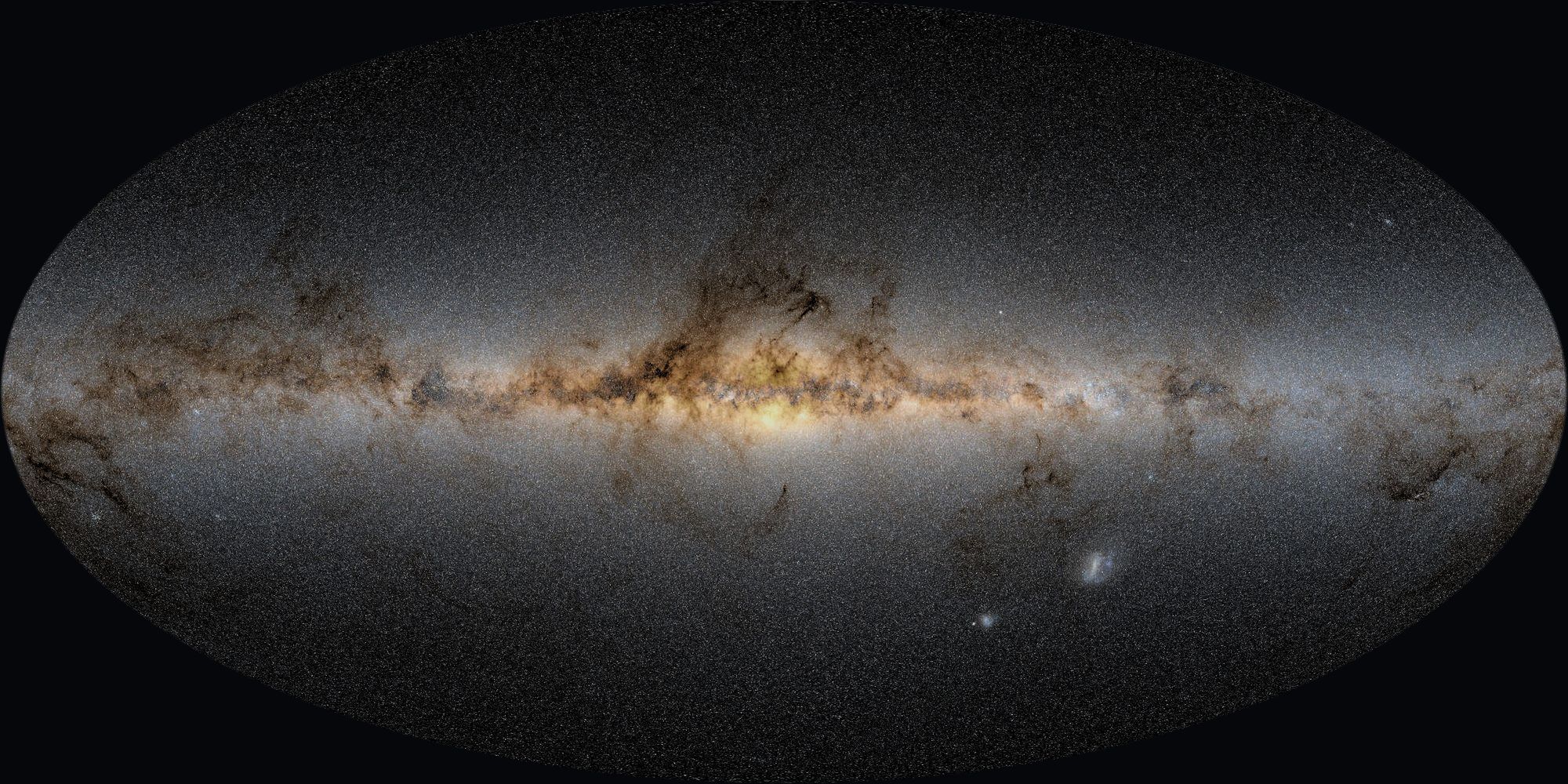
No fields saved yet. The first holder to save a field lights the first cell.
Galactic coordinates, Mollweide projection. Each holder lights the HEALPix cell their aim falls in.
Rarity is read from what is inside
Measured on 240 random addresses against SIMBAD and Gaia DR3, 11 Oct 2026. The highest tier present decides.
The ledger
Every saved field gets the next number. Archive plates and First light plates mint as compressed NFTs at launch, paid for by burning $KEYHOLE.